Food Safety Culture
Through practical guidance and real-world applications, learners will explore how to embed a culture of Food Safety across all levels of an organisation.

Course information
- Location
-
Online
- Next course
-
10th until 25th March 2026
- Application deadline
-
24th February 2026
- Participation Fee
-
Early bird: €575 (RIS and non-RIS countries - 21% VAT included).
€475.21 without VAT
General fee: €675 (RIS and non-RIS countries - 21% VAT included)
€557.85 without VAT
Overview: Food Safety Culture
About : Developed by Social Food
The objective of the course is for participants to achieve the embodiment of Food Safety Culture operations in their workplaces both in the context of the regular everyday work activities but in the context of long-term planning as well.
Upon successful completion of this course, participants will be able to:
- Analyze the Food Safety Management System of their working environment and construct innovative responses to sustainability challenges of its performance through the design and application of Food Safety Culture approach practices.
- Relate and contribute to the mapping of yet non-quantifiable features of the Food Safety Management System of their working environment and mobilize appropriate technologies of collecting, processing and communicating data of behavior-based Food Safety Culture approaches.
- Experiment on new ideas of convergence between inclusion and efficiency towards identifying and resolving risky “short-cuts” of any form throughout the operations of the Food Safety Management System and evaluate these ideas in terms of their validity as sustainable solutions.
- Comprehend the importance of reviewing new knowledge in the discipline of Food Safety and interpret behaviors of different subcultures between various departments of a food company, and develop sustainable solutions for the Food Safety Management System performance of their working environment.
- Demonstrate Food Safety ethical behavior and innovative Food Safety System Management through Food Safety Culture practices and in order to set the example and cultivate common principles and mutual understanding in a single or multi-site Food company.
- Develop and drive coherent messaging, establishment of rewarding systems and two-way inclusive communication beyond “transactional” compliance, and devise the construction of a fair learning environment to enhance Food Safety Systems practices and staff engagement.
Advantages :
- Stay compliant and ahead of the curve: Gain knowledge and understanding aligned with key global standards, research and professional insights from the field of Food Safety Management and Culture.
- Build essential leadership and critical thinking skills: Strengthen your ability to provide root-cause analysis, to design, to lead change and influence the Food Safety Management practices across all levels of an organisation.
- Set the tone of Food Safety Culture in your organization: Request a Corporate or Factory HACCP Team Members Seminar, to provide team build-up and unannounced audit preparedness.
What you'll learn : You will learn the following competencies
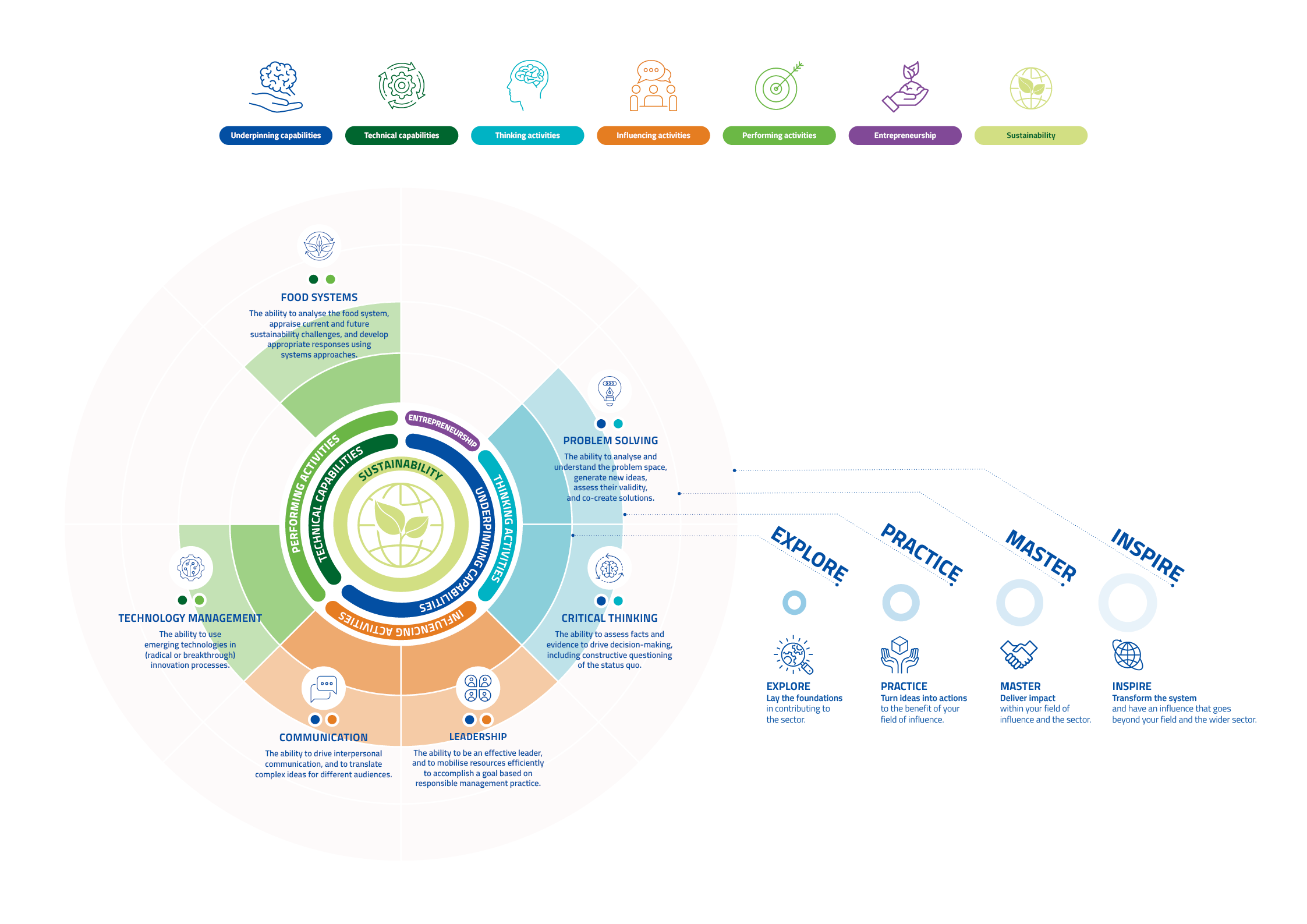

Food systems
- Analyse the food system using a range of systems approaches to appraise current and future sustainability challenges.
- Implement innovative responses to address sustainability challenges in the food system.

Technology management
- Mobilise appropriate technologies in innovation processes.
- Design effective actions to mitigate key unintended consequences of the use of emerging technologies.
Contribute to the development of new technologies for food system transformation.

Problem solving
- Appraise the problem space to identify current and future needs.
- Mobilise effective methodologies to generate new ideas.
- Appraise the validity of new ideas and co-create sustainable solutions.

Critical thinking
- Collect, analyse, interpret and report information to develop sustainable solutions to current and future challenges.
- Appraise unintended consequences of any course of action to devise ethical goals.

Leadership
- Appraise different strategies to deliver a food system innovation.
- Demonstrate leadership towards the implementation of a food system innovation.

Communication
- Devise effective communication methods that support organisational strategies.
- Engage in honest and inclusive two-way communication with stakeholders about their concerns.
- Adjust messaging for different audiences
Structure & Modules : 2-week online programme
During the process, you will have access to practical professional insights, research outcomes and workshop settings on Food Safety Culture, a Transformative and not Transactional Food Safety Systems Management, as regulated both in the EU and the US.
The programme is structured around a combination of lectures, facilitated group work, individual work through self study, leading to a final assessment through available personal mentoring.
Throughout the course, but also during pre-assessment mentoring, you will be provided with the optimum environment in which to set and share your questions or doubts, to shape your ideas, to get support, to learn how to use new tools and then leverage mechanisms of cultivating a positive food safety culture in your organization.
Modules – Sessions
- FSC Basics – Part 1: Introduction, Regulatory and Institutional Guidance
- FSC Basics – Part 2: Setting the Tone – Subcultures
- FSC Broader Considerations – Part 1: Systemic and Humancentric Issues
- FSC Broader Considerations – Part 2: FSC Practical Issues, General Issues and Foresight of Food Safety
Dates for Food Safety Culture 2026
Each programme will take place online over 3 weeks, consisting of 4 sessions (Consecutive Tuesdays-Wednesdays). All sessions start at 15:00 CET and finish at 19:00 CET, with breaks included (4 hours).
MARCH PROGRAMME
- 10/03:FSC Basics – Part 1
- 11/03:FSC Basics – Part 2
- 18/03:FSC Broader Considerations – Part 1
- 18/03:FSC Broader Considerations – Part 2
- 18 to 25/03: Self-study and assessment
JUNE PROGRAMME
- 16/06:FSC Basics – Part 1
- 17/06:FSC Basics – Part 2
- 23/06:FSC Broader Considerations – Part 1
- 24/06:FSC Broader Considerations – Part 2
- 24/06-01/07: Self-study and assessment
OCTOBER PROGRAMME
- 13/10:FSC Basics – Part 1
- 14/10:FSC Basics – Part 2
- 20/10:FSC Broader Considerations – Part 1
- 21/10:FSC Broader Considerations – Part 2
- 21/10-28/10: Self-study and assessment
*All sessions are subject to change, and we will notify participants of any changes as soon as we can.
Key Topics:
- Why Food Safety systems fail beyond the paperwork
- The role of societal values in shaping Food Safety behaviours
- Leadership at every level: top-down and bottom-up engagement
- Leveraging technology to support cultural change
- Aligning mindsets across the organisation
- Insights from global research on Food Safety Culture
- Rethinking Food Safety Management: Common gaps and misconceptions
- Behavioural insights in food safety practice
- Global regulations and guidance on Food Safety Culture
- Setting meaningful, preventive, and outcome-based KPIs
- Moving beyond compliance to build a strong safety culture
- Just Culture principles and Food Safety ethics
Who can attend :
This training is designed for Food professionals who wish to improve their compentencies in Food Safety.
- Students in food-related studies, with a solid understanding of Food Safety Management Standards
- Executives and key team members from food manufacturing companies
- Entire HACCP teams, for stronger collective outcomes
Career opportunities :
This programme opens clear pathways for professional growth across the food industry, primarily in roles that shape, lead, and safeguard Food Safety Management Systems (FSMS). Learners can advance toward positions such as Food Safety Manager, QA Lead, HACCP Team Leader, Internal Auditor, Compliance Coordinator, FSMS Trainer, and Food Safety Culture Change Agent.
The course equips participants with leadership and sociotechnical insight, enabling them to influence decision-making, drive root-cause analysis, lead behavioural and process change, and align organisations with evolving global standards in Food Safety Culture. Graduates gain a competitive edge in careers that require cross-functional leadership, audit readiness, and the ability to cultivate resilient FSMS practices across all levels of a factory or corporate structure.
Training Provider : Social Food


Related courses
View our full course catalogue

